
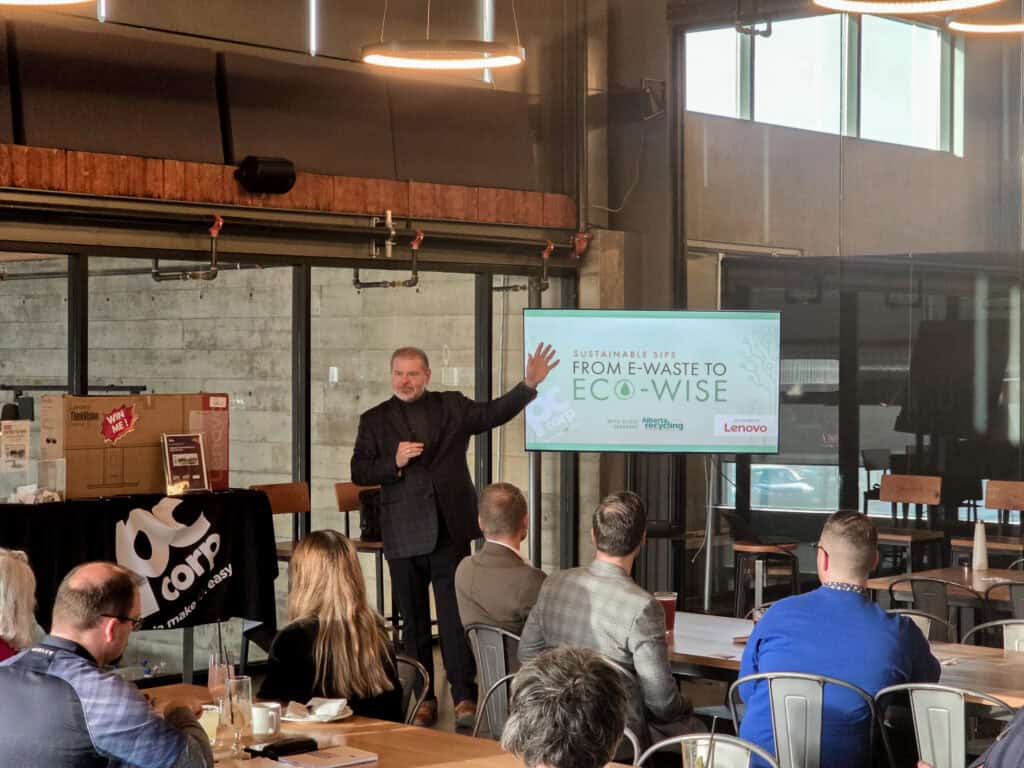
Sustainable IT is becoming a priority for every organization, shaping everything from the devices we choose to how we handle them at end-of-life. That idea was at the heart of Sustainable Sips: From E-Waste to Eco-Wise, a gathering we recently hosted in partnership with Lenovo on November 26th at the Campio Ritchie brewpub in downtown Edmonton.
Our goal was to spark real, practical conversations about building a greener IT future, and the atmosphere helped make those conversations easy.
A lively Q&A kept the discussion moving, Campio’s brewmaster led a guided beer tasting, and a lucky guest walked away with a Lenovo 34” curved monitor in our prize draw. Guests sampled some brews (including non-alcoholic options), enjoyed a spread of pizzas, salads, and wings, and left with Lenovo laptop backpacks stocked with drinks from Campio’s lines of hard and soft beverages.
But beyond the fun, the most important takeaway was this: sustainable IT isn’t abstract. It’s something every organization can influence through small, intentional decisions across the tech lifecycle: procurement, maintenance, reuse, recycling, and everything in between.
If you weren’t able to join us, don’t worry. Below, we break down the ideas and insights that our speakers explored, and provide ideas to build a greener, more responsible IT strategy.

Why Repairable, Longer-Lasting Tech Matters for Your Business
One question came up early in our conversations: Why do so many devices feel disposable, and can we change that? As our event sponsor, Lenovo’s team explored this topic in-depth, offering a refreshingly honest look at how big manufacturers are rethinking design to make technology last longer.
During the afternoon, Alexa Brunner, Sustainability Success Manager at Lenovo, shared how the company is shifting toward something many people have been asking for: products with parts you can actually replace yourself.
Instead of treating laptops like sealed boxes, Lenovo is designing more devices with modular components that users or IT teams can easily swap out. Grounding their products in thoughtful design, they aim to give consumers access to longer-lasting products that deliver better ROI while reducing waste.
Alexa also touched on Lenovo 360 Circle, the company’s global sustainability community that many partners — including PC Corp — participate in, working together to align technology decisions with long-term environmental goals and support more responsible IT procurement practices.
Here are few themes from Alexa’s session that stood out:
- Designing for longevity: Devices should be built to be repaired, not discarded.
- Sharing ideas across the industry: Progress happens faster when everyone learns from each other.
- Connecting daily choices to bigger goals: Everyday decisions — from procurement to retirement — shape your environmental impact more than you realize.

What Really Happens When You Recycle Your Technology
Next, we heard from Darren Turner, Field Service Inspector with the Alberta Recycling Management Authority (ARMA), the not-for-profit that’s been championing electronics recycling in Alberta since 1992 and overseeing the collection, processing, and diversion of regulated electronics from landfills across the province.
Darren gave us a clearer picture of what Alberta’s recycling system actually looks like in practice, starting with something many attendees were curious about: what counts as recyclable?
The list is far broader than most people expect, covering:
- Computers and servers
- Laptops, tablets, and notebooks
- Printers, copiers, scanners, fax machines
- Home small appliances
- AV equipment, telecom devices, toys, and music gear
- Tools, lawn, and garden equipment
- Visual display units and all-in-one devices
In short: if it plugs in or powers on, there’s probably a recycling stream for it.
Inside the Recycling Journey
Darren also walked us through the journey electronics take once they enter Alberta’s system. Devices are broken down through manual disassembly or shredding, separating metals, plastics, glass, and precious materials.
Afterwards, those components become commodities that manufacturers can reuse. For example, a hard drive’s magnets are separated to recover nickel and cobalt, both highly valuable materials that can be fed back into the supply chain.
This process creates real economic value from items most people consider “dead tech” and has had an incredible impact on the province’s waste reduction and resource recovery. Due to ARMA’s work, Alberta has recycled 275,404 tonnes of electronics since 2004, a testament to how much progress can happen when recycling systems are standardized and widely supported.
So, what does this mean for your organization?
ARMA’s session highlighted the importance of knowing where your old hardware actually goes. Not only is proper recycling an effective tech habit that reduces your environmental impact, but it also helps you reduce your data security risks, especially when an experienced IT provider oversees the process. They’ll handle the full cleanup, including wiping hard drives and removing any asset tags or labels that tie the device to your organization.

Practical Steps Any Business Can Take Today
Our final session was led by PC Corp’s own Jeffrey Jansen, Vendor Relationship Officer, and recent Trust X Alliance Hall of Fame inductee. He shared a practical look at what sustainability can look like inside any organization, no matter its size. His message was clear: you don’t need a massive ESG budget to make meaningful progress. Small, thoughtful habits go a long way.
Small actions with big ripple effects
Here are some of the simple, everyday practices that Jeffrey highlighted that create real impact over time:
- Work with responsible manufacturers. Partnering with companies like Lenovo, who design more repairable and longer-lasting devices, naturally reduces waste.
- Separate recyclables and dispose of materials responsibly. Retired hardware, batteries, cables…they all add up. Routing them through proper streams keeps them out of landfills, while also supporting the circular economy.
- Rethink how you run events. When planning an occasion, make sure to choose local suppliers, avoid single-use items, and offer giveaways people will actually keep and use. You’ll both reduce waste and reinforce sustainability as part of your culture.
- Go green with office and cleaning supplies, and turn it into policy. From making sustainable practices like this and others into the default at PC Corp, it’s helped our team stick with the habit.
These are small changes, but they stack up across months and years.
You’re doing more than you think
One of Jeffrey’s points that resonated with the room was the importance of documenting what you’re already doing. Most organizations underestimate their efforts — recycling programs, responsible purchasing, greener office practices — because they treat them as routine. But once you write them down, it becomes easier to see what’s already working and where you can build next.
These kinds of practical, incremental improvements support:
- Lower operating costs
- More efficient use of technology
- Reduced waste
You don’t need a big reset to move toward greener IT. A few steady changes are often all it takes, and every business can start from whatever stage they’re at.
Recycle Your Assets Responsibly with PC Corp
If there was one theme that carried through Sustainable Sips, it was this: meaningful progress in sustainable IT comes from everyday decisions. Everyone left feeling encouraged after learning practical information about how devices are built, how they’re recycled, and how small habits inside a business can reduce waste.
We closed the event by sharing a quote from environmentalist Robert Swan that captured that spirit perfectly:
“The greatest threat to our planet is the belief that someone else will save it.”
Too often, people think that it’s the bigger industry players who are solely responsible for making IT more sustainable. And while they play a critical, impactful role, improving the environmental impact of our technology also involves starting with what we can do today. Sometimes that looks like selecting more repairable hardware, sometimes it’s disposing of equipment responsibly, and sometimes it’s as simple as improving a process in your own office.
If your organization is ready to put these ideas into action, PC Corp can help you build a responsible asset-disposition plan that protects your data. Contact us to work with our IT procurement experts and improve your environmental impact today.

